
Author: Zhou, ChainCatcher
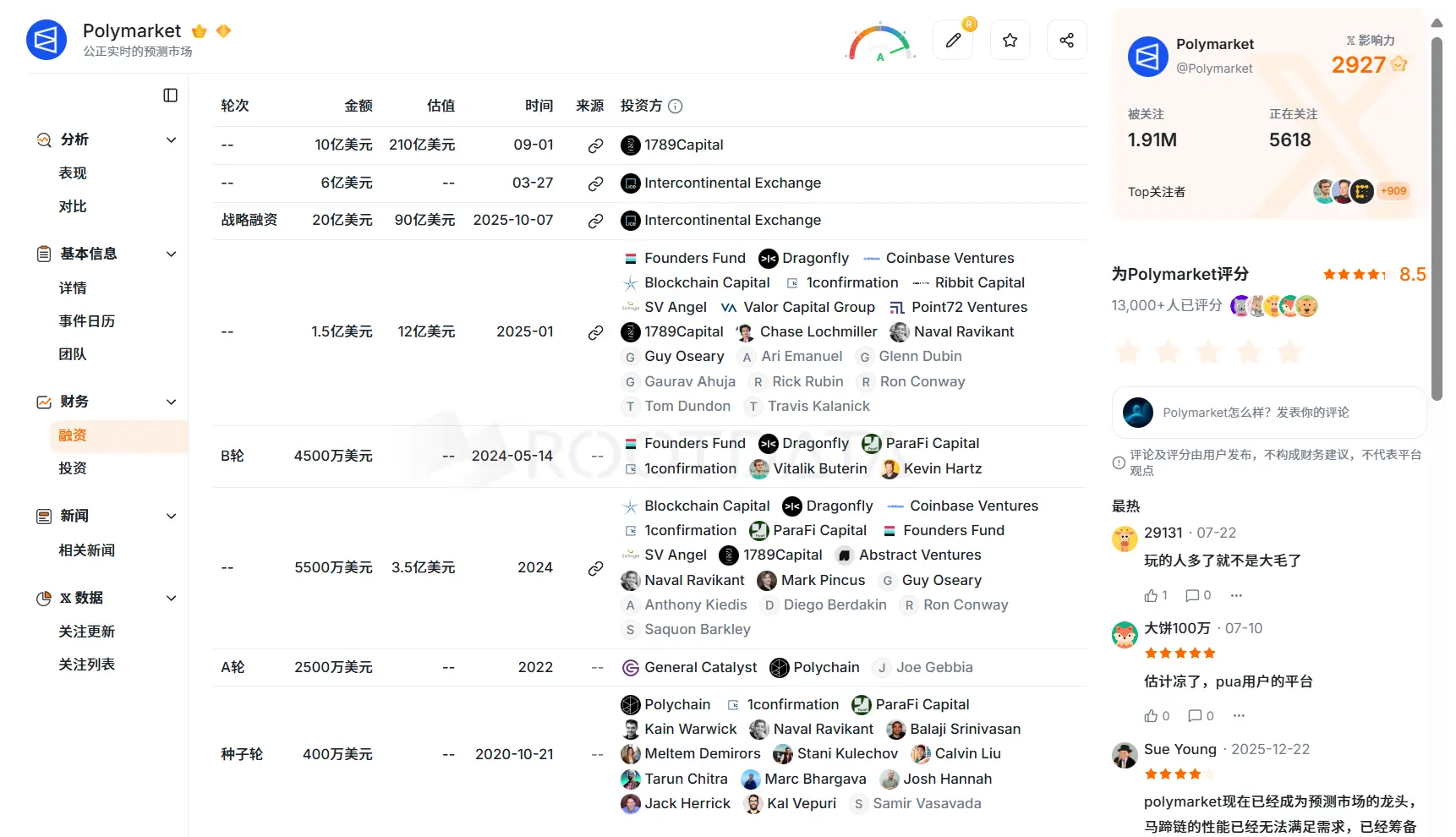
According to WSJ reports, 1789 Capital, an investment fund in which Trump’s eldest son, Donald Trump Jr., is a partner, plans to invest an additional approximately US$300 million in the prediction market platform Polymarket.
The funding is part of a new $1 billion round led by 1789 Capital, and the deal, if completed, is expected to value Polymarket at about $21 billion. 1789 Capital has previously invested approximately US$200 million in Polymarket and is expected to become one of its largest shareholders upon completion of this round.
The past and present life of 1789 Capital
1789 Capital was founded in October 2022 by a founding team consisting of investment bankers Omeed Malik, Rebekah Mercer and entrepreneur Chris Buskirk, with Malik serving as president.
Malik graduated from Colgate University and Emory University School of Law. He worked as a corporate lawyer in his early years, then moved to MF Global, and then to Bank of America Merrill Lynch, where he was responsible for the prime brokerage business.
Malik left the company in early 2018 amid an investigation into allegations by subordinates, and later filed a $100 million arbitration claim accusing the bank of defamation and discrimination. In July of that year, Bank of America agreed to pay an undisclosed amount of millions of dollars to settle the matter, and the two parties did not make a final conclusion on the facts themselves.
Malik has since founded boutique investment bank Favahar Partners, invested in conservative new media projects, and also served as chairman of a SPAC. According to his own review, the change in political stance began with dissatisfaction with the government's response to the new crown epidemic. Since then, his investment narrative has gradually shifted to anti-ESG and anti-DEI.
After the 2024 election, Trump Jr. joined 1789 Capital as a partner, and the fund has grown rapidly since then.
Its growth equity fund, which started 2025 at about $150 million to $200 million, topped $1 billion by September of that year, hit $2 billion and closed to new investors by the end of December. By May 2026, AUM had risen to approximately $3.5 billion, an increase of approximately 17 times from early 2025.
This fund invests in a wide range of areas. The artificial intelligence side includes Cerebras, Groq, Perplexity, Databricks and Crusoe, the defense industry side includes Anduril, Hadrian and Vulcan Elements, the consumer side includes e-commerce platform GrabAGun, e-cigarette brand Juul and PublicSquare, and the space side covers SpaceX and Axiom Space. It also participated in the financing of Musk's Neuralink, X and xAI.
According to CNN, in the first 500 days of Trump’s second term, ten defense, aerospace and software companies invested by 1789 Capital have collectively received more than $1.6 billion in federal contracts and grants. 1789 responded that it had never discussed federal contracts with the government for the portfolio companies. Trump Jr. said he does not contact federal agencies for companies he invests in or advises.
One of the most high-profile cases is Vulcan Elements. In August 2025, 1789 Capital completed its investment when the company was valued at approximately $200 million. Three months later, the company's valuation jumped to about $2 billion when the Pentagon loaned it $620 million and the Commerce Department added an additional $50 million. Senator Elizabeth Warren and others signed a letter alleging that the deal involved serious interest peddling.
Polymarket is another unavoidable name for this establishment. Trump Jr. has served as a paid strategic advisor to Kalshi since January 2025 and has been awarded approximately $300,000 worth of company stock. In August 2025, he joined the Polymarket Advisory Board based on 1789 Capital’s investment in Polymarket.
The two companies were direct competitors and he sat at the tables of both. His spokesperson responded that this would not change his role at Kalshi. At the same time, Trump Media Group once planned to embed its own prediction product Truth Predict on Truth Social and discussed providing Truth API to Wall Street.
According to Fortune, although there is currently no public evidence that Donald Trump Jr. or the Trump family used government insider information to trade, potential conflicts of interest surrounding the intersection of the president’s public information, market transactions and family business interests are attracting attention from the outside world.
Valuations are running wild, revenue is a mystery, Polymarket’s capital game
Polymarket's valuation jumps almost always follow a regulatory or capital event.
In 2022, the U.S. Commodity Futures Trading Commission determined that it was unregistered to operate a derivatives exchange, fined it $1.4 million, and required that U.S. users be blocked. The platform then turned to overseas operations and settled event contracts with on-chain stablecoins.
The 2024 U.S. election became a turning point, and political betting turned Polymarket into a global public opinion market. The trading volume increased significantly in the fourth quarter of that year.
In July 2025, the Department of Justice and the CFTC ended their previous investigation of the platform and did not prosecute. On the 21st of the same month, Polymarket invested US$112 million to acquire QCEX, a licensed exchange and clearing house, and obtained the shell resources to return to the US market. On August 26, 1789 Capital announced a strategic investment, and Trump Jr. also joined the advisory board.
In October 2025, Intercontinental Exchange, the parent company of the New York Stock Exchange, committed to investing up to US$2 billion, with a pre-money valuation of approximately US$8 billion. On November 25, the CFTC issued an amended designation order allowing its U.S. entities to operate in the United States as a futures broker intermediary model. After the regulatory door was opened, traditional finance began to enter the market on a large scale.
In March 2026, Intercontinental Exchange invested another $600 million. The company disclosed that it holds a cumulative position of approximately US$1.6 billion, accounting for approximately 22% of the issued shares. It is currently the largest institutional shareholder (it recently stated that it may continue to increase its position). In April 2026, a round of financing introduced D.E. Shaw, G Squared and other institutions, with the valuation reaching approximately US$15 billion. Now 1789 Capital is leading a new round of investment of about US$1 billion, with its own investment of about US$300 million. The post-investment valuation is expected to be US$21 billion. After the completion of this round, it will also be among the largest shareholders.
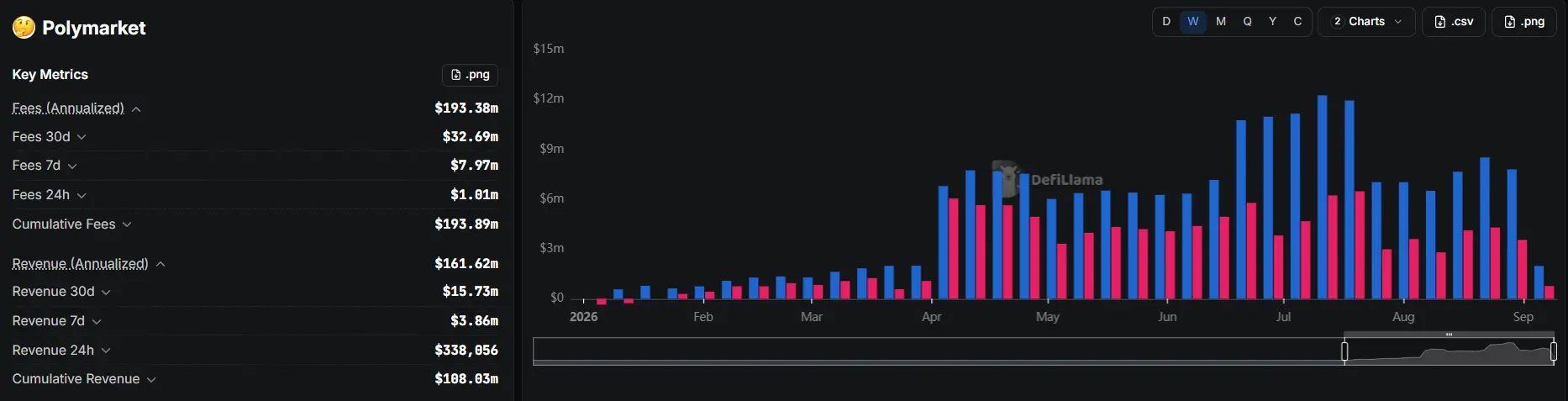
Behind the surging valuations, the revenue figures cannot tell a unified story. Polymarket started charging traders fees in January 2026. The extrapolated annual revenue figure given by the third-party platform Sacra is about US$1 billion, and the annualized revenue calculated by the on-chain data platform DefiLlama is about US$162 million, a difference of nearly 8 times. Based on a valuation of US$21 billion, the price-to-sales ratio is about 21 times using the former, and nearly 130 times using the latter.
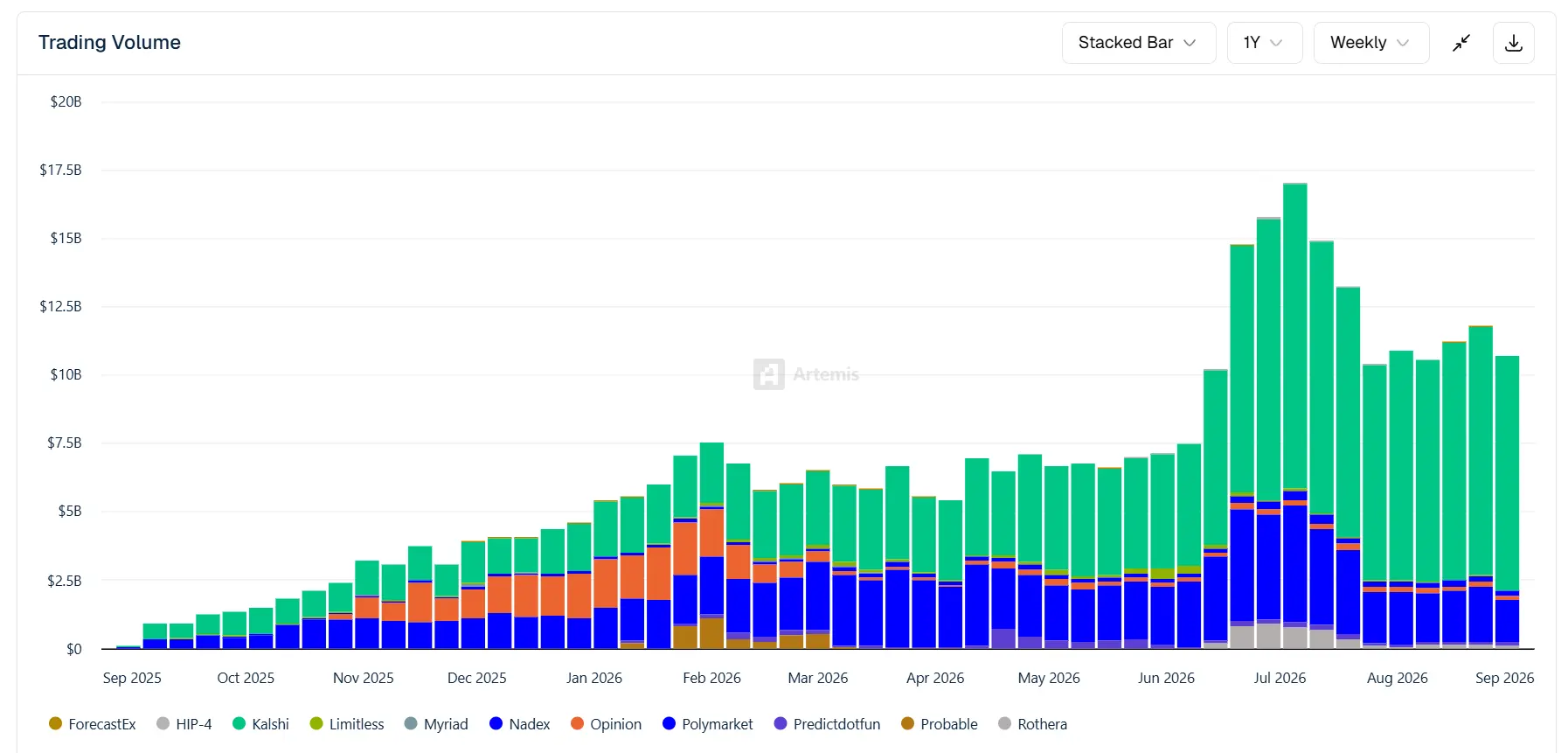
Data platform Artemis shows that from October to December 2024, the prediction market is almost Polymarket’s market. This year, the situation began to reverse. The World Cup once pushed the market's weekly turnover to about 17 billion U.S. dollars. After the game, it remained at more than 10 billion U.S. dollars per week, but the increase mainly went to competitor Kalshi.
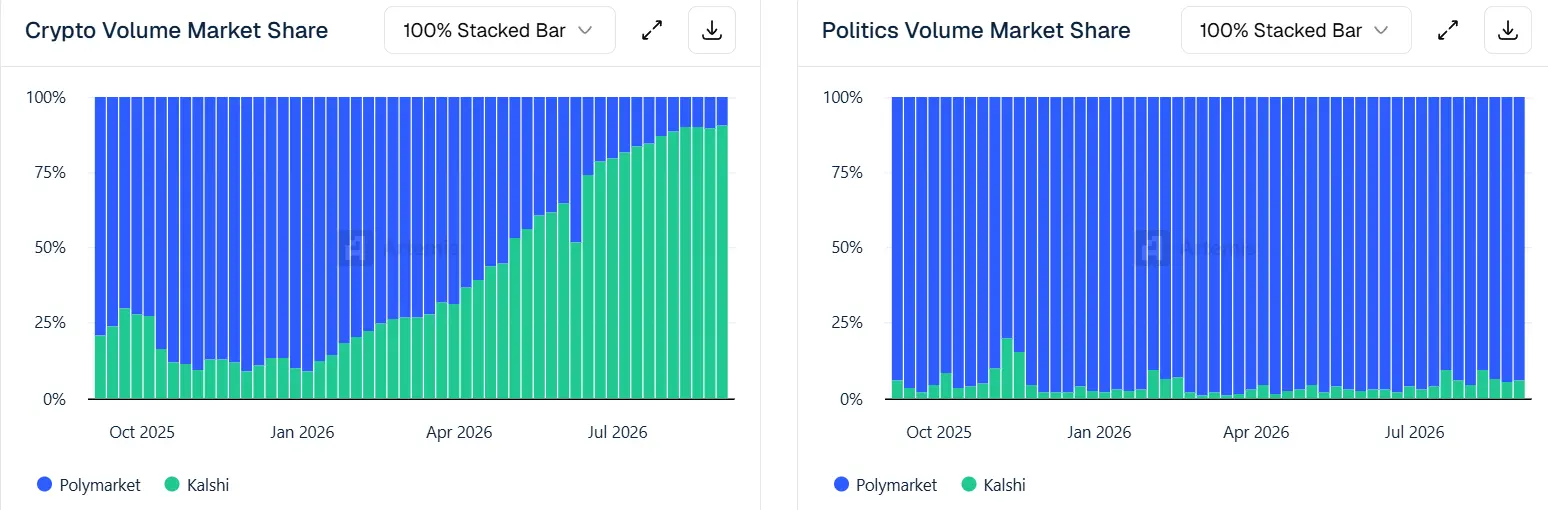
By August, Kalshi’s non-sports transaction volume was approximately US$24.9 billion, while Polymarket’s was only approximately US$1.5 billion; Polymarket’s share of the crypto category fell from approximately 80% to approximately 10% within a year. Political market is still Polymarket’s home field, occupying about 90% share for a long time.
Even though it has regained its US compliance license, Polymarket’s business focus is still overseas. On-chain data shows that in the week of August 30, international users contributed approximately US$1.4 million in fee income, and American users contributed approximately US$610,000. International accounted for more than 70%, and the transaction volume structure was roughly the same.
More importantly, prediction markets are no longer exclusive to the two companies. After the trading volume increases, both centralized exchanges and on-chain protocols are squeezing in. For Polymarket, this means that both sides are under pressure.
Coinbase has opened predictive trading to US users since the beginning of the year, and orders follow Kalshi's compliance track. The company claims that this is one of the fastest new products to be launched online. Robinhood embedded event contracts into the brokerage app earlier, first guiding traffic to Kalshi, and then preparing its own licensed exchange Rothera. Crypto.com makes OG, Gemini makes Predictions, and Interactive Brokers’ ForecastTrader and Webull have also launched similar products. Traffic entrances are shifting from crypto-native websites to brokerages and exchanges that already have capital accounts.
The other side of the chain is also splitting. Limitless on Base does 15-minute and hour-level encrypted short-cycle trading, with monthly transactions ranging from one billion dollars to one billion dollars. Opinion and Predict.fun on BNB Chain eat macro themes and Binance wallet traffic respectively. Myriad is going to be embedded in the media, Azure provides the bottom layer of the market for dozens of front-ends, and Hyperliquid uses HIP-4 to connect the result contracts into its own order book.
Capital is rushing to enter the market, and the market is becoming more and more crowded, which makes the issue of exit more urgent. Exports on the capital side are nothing more than currency issuance and listing. Last year, Polymarket executives publicly stated that there would be tokens and airdrops; the parent company Blockratize applied to register the POLY and $POLY trademarks in February this year. ICE’s cooperation announcement also mentioned future tokenization arrangements, but the specific issuance time and airdrop rules have not yet been finalized.
The company has not yet submitted a listing prospectus. JPMorgan Chase ended its bank cooperation with Polymarket last year due to regulatory risks, but the bank said it still maintains multiple business relationships with the company and will consider participating in future IPO underwriting.